Categories
Staking the Throne

Second Impressions

It is the time for Board Date Project to commence. My submission Staking the Throne (see the original post First Impressions) did get through the preliminary step… but only barely. The organizers skipped it first, but they asked to view the game rules just in case—and the rules got the design through. So it’s probably safe to say that the first impression did not hit the mark. And I guess this is one of those rare occasions in which one gets to redo the first impression.

Hence I’ve been working on the pitch video. I had some… visions… involving a green screen and Tabletop Simulator, but I kind of run out of time (and perhaps luckily so). Here’s the pitch:

And here’s the adjusted specs and description:

  • Players: 3 to 5
  • Playing Time: 15 minutes/game
  • Primary Mechanic: Auction: Sealed Bid
  • Game Type: Competitive
  • Audience: Family + (Medium Heavy)
  • Youtube Description: A board game design for 3-5 players, which features blind bidding and set collection. In this game the auctions are held in pairs, into which players divide their limited bidding resources. Check it out, especially if you happen to like For Sale or High Society.
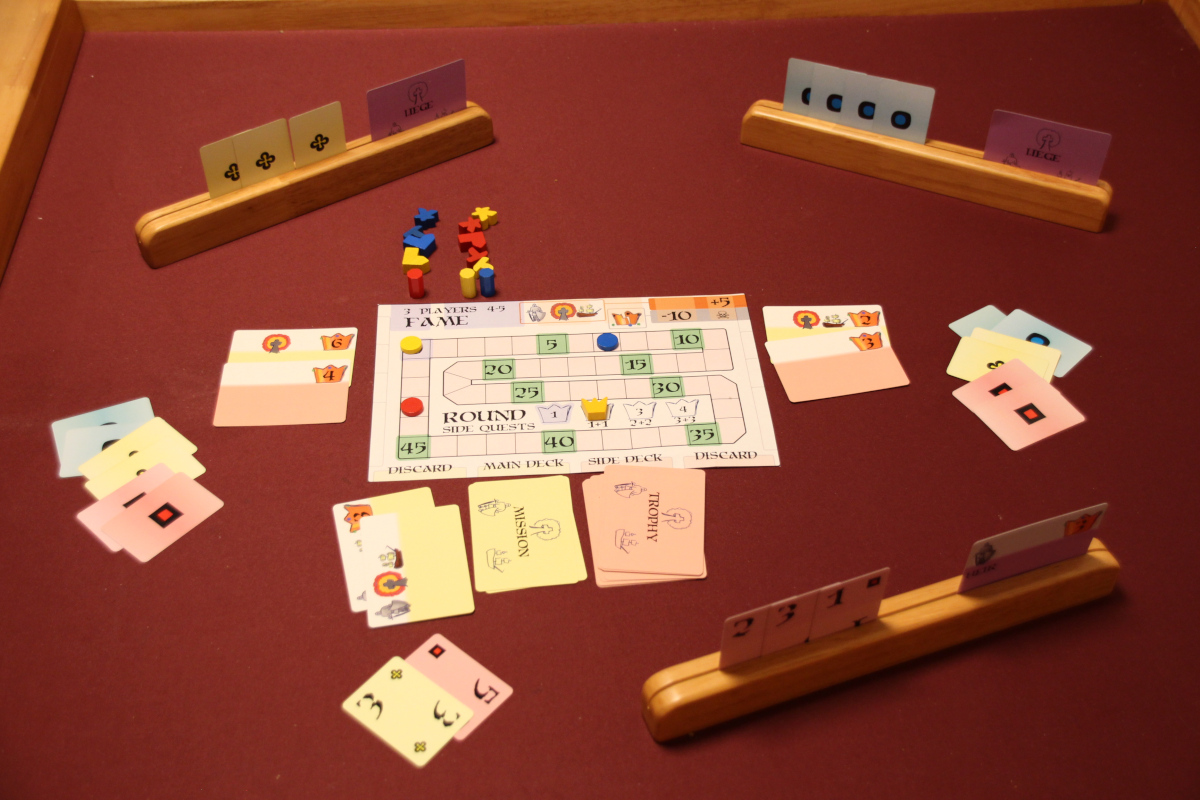
The number 200 has been mentioned as the total number of pitches. I might be missing the WOW factor to stand out… but as they used to say once upon a time: Alea iacta est!
Categories
General Staking the Throne

Everybody was tie-breaking

In games with simultaneous actions, it is often necessary to determine what happens first and to whom. I’ve got a bit of a personal case study in the subject known as “Staking the Throne”. The core of the design—simultaneous blind bidding and set collection—has persisted, but pretty much everything else has shifted back and forth during the years:

  • “v0.1 Profiteers (2015)” was the very first version of the game: The players were allowed to choose when to win a tie or whether to save that possibility for later. The ties were common, so this slowed down the gameplay considerably.
  • “v1.0/v2.0 Roar for the Throne (2015)” had basically the same thing for ties, but players were forced to cash in their possibilities.
  • “v3.0 Symboletto (2016)” is the only published version of the game… well… if you count a small print run of 70 copies as “published”. The tie-breaking was streamlined a bit, but effectively this was still the same (i.e., check who won, update the order afterward). The bigger changes were in other mechanics, which reduced the number of ties quite a bit.
  • “v4.0/v5.0 Bets and Bids (2018)” had no changes with respect to tie-breaking.
  • “v6.0/v7.0 Staking the Throne (2020)” had ties broken by unique value (eliminating the need to update the tie-breaker).
  • “v8.0 Staking the Throne” has no tie-breaking! This was enabled by having differents tracks for points as well as for sets, so now rewards could be given to all players involved.

The journey has been rather long, starting from a clunky solution to an issue, which in the end turned out not to even exist. This actually reminds me of a Ravensburger game design video I watched recently, in which one piece of advice was to “Instead of adding stuff to cope with something, fix the underlying issue.”

Getting back to the topic: In my humble opinion, there should not be tie-breaking during gameplay, as it breaks the game flow, complicates rules, and could be unfair. For instance, tossing a coin gets the job done, but that would not have anything to do with the game. And sometimes you need to break and shake things around until they fall into positions, which allow you to get through neatly. So join with me: No more ties! No more ties! No more ties!

Categories
General

Where Is Fun?

I have been playing games for quite a while, mostly with my regular gaming group but also making visits to gaming clubs every now and then. The game circulation has been rapid… not that many games get more than 2-3 trials after they are forgotten. Not because they would not be fine games… but with limited time tough choices has to be made.

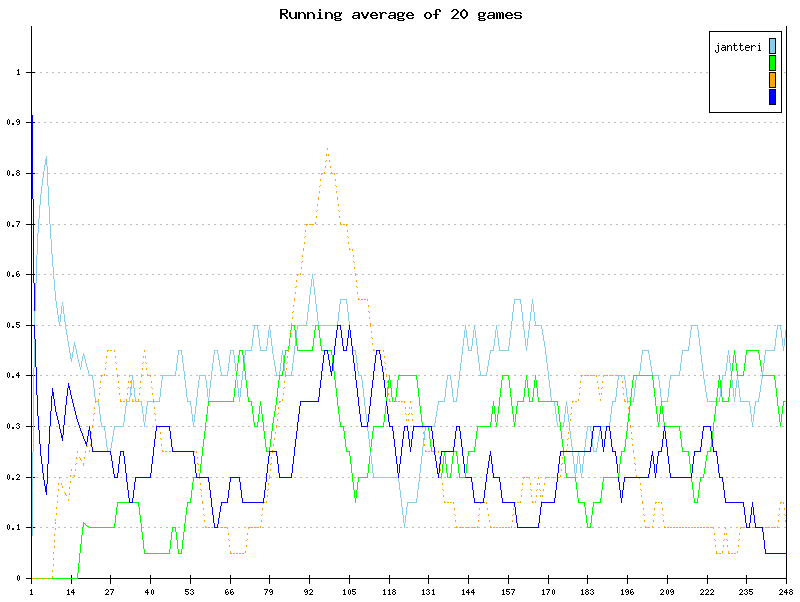
So which games do get onto the table again and again? Luckily, I have been gathering statistics over the years:

  • Love Letter: A guess and bluff game which I do not like.
  • For Sale: A game with open bidding and blind bidding. This is ok, but not necessarily my first pick for a filler.
  • Nexus Ops: A dice fest with building troops, fulfilling missions, and sneak attacking opponents… and again a game I’m not a huge fan of.
  • Trans Europa+: Building railroads and profiting from others’ hard work. I quite like this one!
  • Coloretto: A simple set collection game that just works.

My favorite games are not on the list… and I guess the conclusion is that I like games that are not fun. Or let’s rephrase it: I like games with little or no luck after the setup (“let the best player win”) and non-direct player interaction (“no kingmaking, please”)… these games are enjoyable and fun when you are playing with players of equal skill.

From the board game design perspective, I have probably been avoiding luck too much. The common nominator in the list above is that every player has a chance of victory, but there is a decent amount of skill involved in the success. So beware Fun, I know you are lurking around the balance point between skill and luck, and I’m gonna get ya!

Categories
General Staking the Throne

To Boldly Prototype…

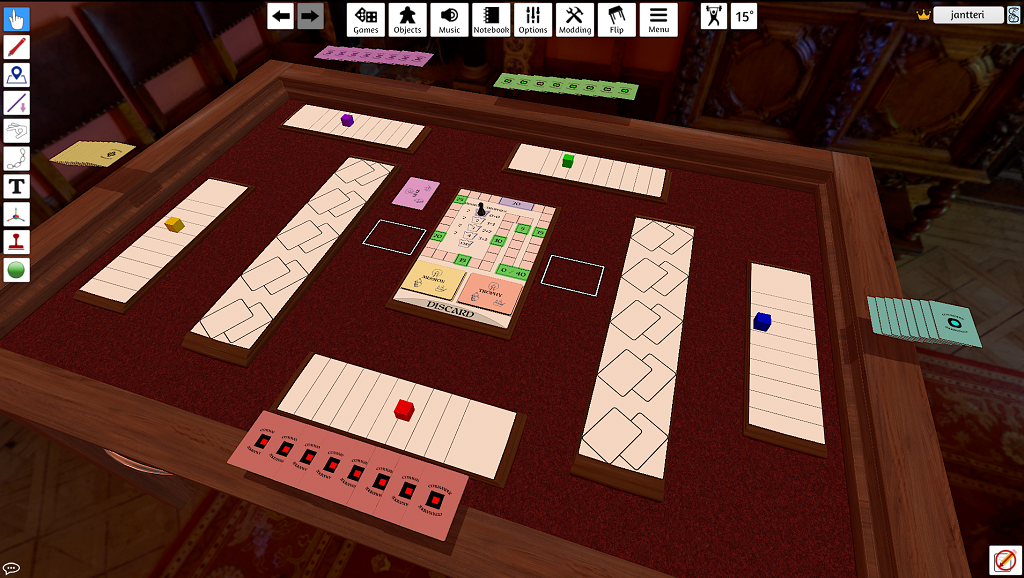
…in Tabletop Simulator. It took a while, but I finally managed to make the leap. And it only took two nights or so to import the graphics, make components, and create snapping points to make a playable version of Staking the Throne.

My regular gaming group gave it a go… and indeed: the game could be played, playing didn’t take that much time, and the game worked (or let’s say it had its moments). The game was definitely not perfect, but it was a good testing session.

Regarding Tabletop Simulator, there are plenty of good reasons for using it: a lot of functionality exists already, prototyping is faster, prototyping is cheaper, and there are more possibilities for playtesting. Unfortunately, there’s a bit of a learning curve… and when you do want to play/test with your friends, you need to get them to buy it too.

For completeness sake, the other framework out there is Tabletopia. On afterthought, getting a framework for online prototyping is a no-brainer for an enthusiastic game designer. Assumably in the end the framework probably does not matter that much, as each of the frameworks has its strengths and weaknesses. So if you are hesitating about online prototyping… stop thinking and start clicking instead.