Categories
General

Where Is Fun?

I have been playing games for quite a while, mostly with my regular gaming group but also making visits to gaming clubs every now and then. The game circulation has been rapid… not that many games get more than 2-3 trials after they are forgotten. Not because they would not be fine games… but with limited time tough choices has to be made.

So which games do get onto the table again and again? Luckily, I have been gathering statistics over the years:
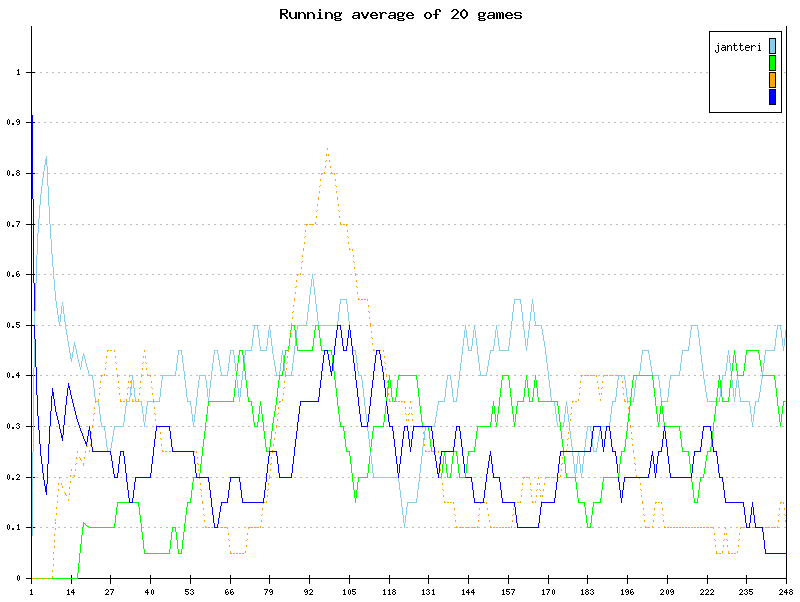
  • Love Letter: A guess and bluff game which I do not like.
  • For Sale: A game with open bidding and blind bidding. This is ok, but not necessarily my first pick for a filler.
  • Nexus Ops: A dice fest with building troops, fulfilling missions, and sneak attacking opponents… and again a game I’m not a huge fan of.
  • Trans Europa+: Building railroads and profiting from others’ hard work. I quite like this one!
  • Coloretto: A simple set collection game that just works.

My favorite games are not on the list… and I guess the conclusion is that I like games that are not fun. Or let’s rephrase it: I like games with little or no luck after the setup (“let the best player win”) and non-direct player interaction (“no kingmaking, please”)… these games are enjoyable and fun when you are playing with players of equal skill.

From the board game design perspective, I have probably been avoiding luck too much. The common nominator in the list above is that every player has a chance of victory, but there is a decent amount of skill involved in the success. So beware Fun, I know you are lurking around the balance point between skill and luck, and I’m gonna get ya!
Categories
General Staking the Throne

To Boldly Prototype…

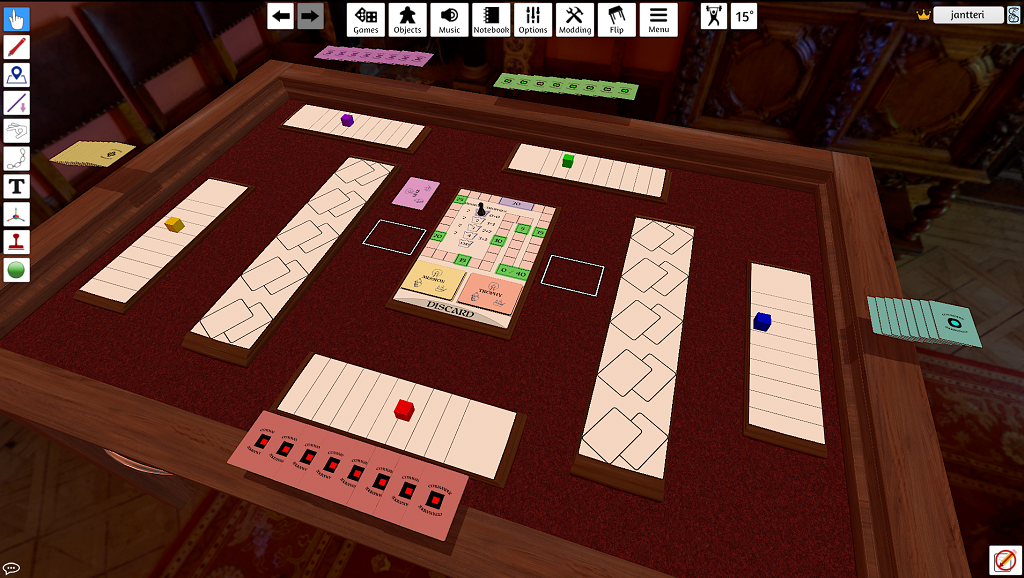
…in Tabletop Simulator. It took a while, but I finally managed to make the leap. And it only took two nights or so to import the graphics, make components, and create snapping points to make a playable version of Staking the Throne.

My regular gaming group gave it a go… and indeed: the game could be played, playing didn’t take that much time, and the game worked (or let’s say it had its moments). The game was definitely not perfect, but it was a good testing session.

Regarding Tabletop Simulator, there are plenty of good reasons for using it: a lot of functionality exists already, prototyping is faster, prototyping is cheaper, and there are more possibilities for playtesting. Unfortunately, there’s a bit of a learning curve… and when you do want to play/test with your friends, you need to get them to buy it too.

For completeness sake, the other framework out there is Tabletopia. On afterthought, getting a framework for online prototyping is a no-brainer for an enthusiastic game designer. Assumably in the end the framework probably does not matter that much, as each of the frameworks has its strengths and weaknesses. So if you are hesitating about online prototyping… stop thinking and start clicking instead.

Categories
General Staking the Throne

Rulelativity Theory

Not so long time ago a had a pitching session with Ravensburger. It went rather badly (perhaps that’s a topic for another post). One of the games I pitched was Staking the Throne. It finally dawned on me while I was trying to explain to the editor that “the game is rather simple” — the prototype had a big problem with its rules.

The Google doc of the rules had 8 pages. There were examples with illustrations, so it wasn’t that dense… but still for a filler game which takes 20-30 minutes that is a lot. So I pondered over the design’s mechanisms… what can be cut, simplified, or altered for clarity:

  • The design featured “double-blind-bidding”: you made a blind bid (with a card) to qualify to make another blind bid (with a dial) to actually score some points… since the first bid was effectively just to single out the last player, I decided this wasn’t worth the hassle.
  • The rounds “crew bigger” and evened out tiebreaking… but this was done awkwardly, which complicated both the setup and the gameplay. With some tinkering, I could achieve the same effects in a more straightforward fashion.
  • Letting players have “infinite Gold”. Previously Gold was one resource to players to manage, but handling accidental overbidding was an annoyance. And with the limited Gold it was necessary to distribute Gold back to the players every now and then (i.e., effectively a bookkeeping shore).
  • I added a unique tie breaker number on the bidding cards. This makes the components per player asymmetric and possibly slightly unbalanced… but this should be fine as long as they are perceived fair (although I’m sobbing a bit within). I did scale up the bidding a bit to make ties less likely.

In the end, I think, the playing time was shaved and the rules were effectively halved. So it took one bad pitching session for me to be “pushed” to make changes that probably should have been done a long time ago… hence… to the playtesting grounds and beyond!

Categories
General

Challenge Yourself

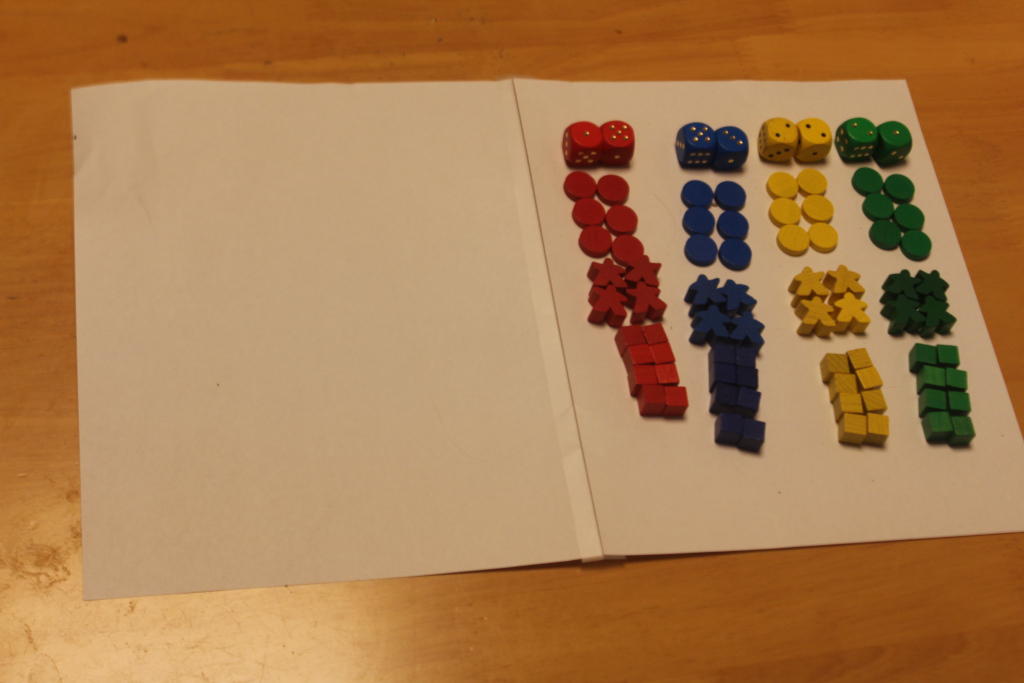
The Game Crafter (TGC) announced a new contest Community Anthology Challenge. I find these contests quite inspiring, as often you will need to push the design restrictions in order to carry out your vision. Here are the allowed components as well as the total printable space for rules and a game board (no cards, mats, etc.):

I will certainly think about this contest to see if I’ll manage to scrape something interesting together in the following ~3.5 months. I would assume that replayability will be a big challenge:

  • Components would definitely allow simple (w.r.t. rules) and challenging abstract games to be designed… but the gameplay might be too similar from one game to another.
  • Dice could be used in the setup to build unique circumstances from game to game. However, this would be better implemented with cards, for instance. Hence it would be a bit “lazy” design, if and when there exists a better way.

It will be interesting to see how popular this contest will be. Due to Covid-19, there haven’t been TGC contests for a while… so there might be some accumulated interest. On the other hand, this feels a bit similar to their earlier Game Pieces Only Challenge, which had 53 entries (I actually had two not-so-successful entries there). For the fun of it, let’s guess that there will be 65 entries this time.